
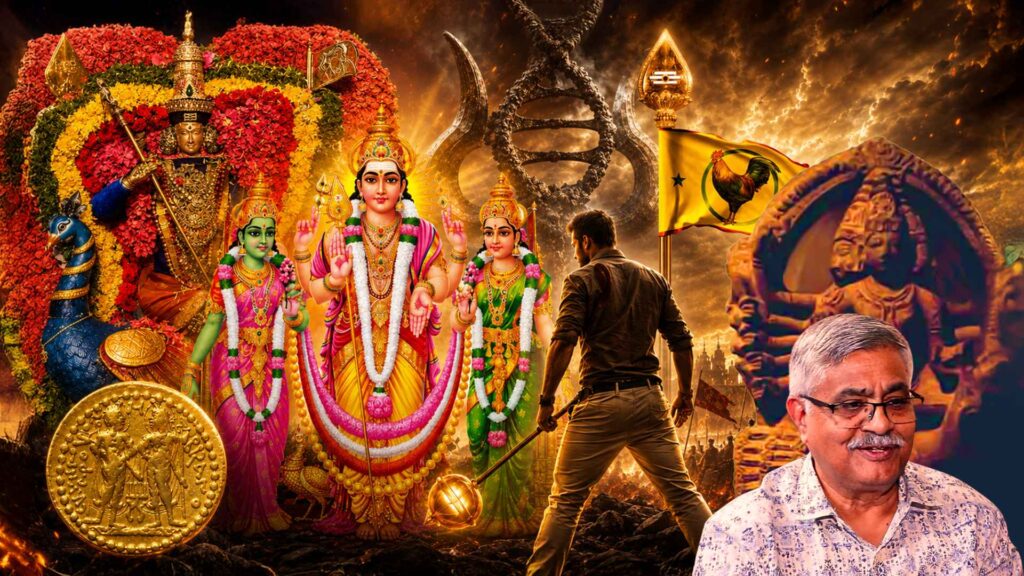
मुरुगनला तमिळ देव का म्हटले जाते? ज्युनियर एनटीआरच्या चित्रपट वादाच्या पार्श्वभूमीवर भारतविद्या अभ्यासकाने खुलासा केला.

ज्युनियर एनटीआरच्या आगामी चित्रपटाच्या टॅगलाइनवरून निर्माण झालेल्या वादामुळे इतिहास, श्रद्धा आणि ओळख यांवरील एक व्यापक चर्चा पुन्हा सुरू झाली आहे. विद्वानांच्या मते, भगवान मुरुगनच्या उगमास केवळ एका भौगोलिक दाव्यापुरते मर्यादित ठेवणे, हे त्यांच्या अधिक स्तरित सांस्कृतिक उत्क्रांतीचे अतिसुलभीकरण आहे.
जरी टीझरमध्ये मुरुगनचा जन्म उत्तरेत झाला आणि दक्षिणेत त्याची पूजा केली जाते असे दाखवले असले तरी, इतिहासकारांच्या मते या मुद्द्याकडे केवळ पौराणिक कथा किंवा राजकारणाच्या दृष्टिकोनातून पाहता येणार नाही.
‘द फेडरल’ने प्रख्यात भारतशास्त्रज्ञ राहुल बालकृष्णन यांच्याशी मुरुगन उपासनेच्या ऐतिहासिक उत्क्रांतीबद्दल, मुरुगन, स्कंद आणि कार्तिकेय यांच्यातील संबंधांबद्दल, तसेच ही चर्चा सिनेमाच्या पलीकडे जाऊन संस्कृती, साहित्य आणि मानववंशशास्त्राच्या प्रश्नांपर्यंत का पोहोचते, याबद्दल संवाद साधला.
चित्रपटाच्या टॅगलाइनवरील आक्षेप इतिहास, श्रद्धा किंवा राजकारणातून आला आहे का?
मी म्हणेन की यात इतिहास, संस्कृती आणि राजकारण या तिन्ही गोष्टींचा समावेश आहे. पण त्याचबरोबर हा निव्वळ सिनेमासुद्धा आहे. टॅगलाइन अनेकदा वाद निर्माण करण्याच्या उद्देशानेच तयार केली जाते. वैयक्तिकरित्या, मी त्याकडे पूर्णपणे दुर्लक्षही करणार नाही आणि एका मर्यादेपलीकडे त्याला फार गांभीर्यानेही घेणार नाही.
जेव्हा एखादा अखिल भारतीय चित्रपट बनवला जातो, तेव्हा सर्व काही सांस्कृतिकदृष्ट्या तटस्थ दिसावे यासाठी प्रयत्न केला जातो. पात्रे तमिळनाडूची असली तरी, त्यांची वेशभूषा आणि सादरीकरण अधिक सार्वत्रिक भारतीय वाटावे अशा प्रकारे बदलले जाते. यामुळे डबिंग सोपे होते आणि प्रेक्षकवर्ग वाढतो. मी या टॅगलाइनकडेही त्याच दृष्टिकोनातून पाहतो.
हे सुद्धा वाचा: एनटीआर-त्रिविक्रमच्या ‘मुरुगन’ चित्रपटामुळे तमिळमध्ये वाद का निर्माण झाला आहे?
जेवढे जास्त लोक याबद्दल बोलतील, तेवढा या घोषणेचा उद्देश साध्य होईल. संपूर्ण तामिळनाडूमध्ये यावर चर्चा होणे, याचा अर्थ उद्दिष्ट आधीच साध्य झाले आहे.
मात्र, एक शिक्षणतज्ञ आणि संशोधक म्हणून माझी रुची वेगळ्याच विषयात आहे. मी या विषयाकडे शैक्षणिक दृष्टिकोनातून पाहतो. आपल्याला मुरुगनला समजून घेणे, त्याचा उगम समजून घेणे आणि आपण नेमके कोणाबद्दल बोलत आहोत हे समजून घेणे आवश्यक आहे.
जेव्हा आपण मुरुगनबद्दल बोलतो, तेव्हा आपण मुरुगन, स्कंद, कार्तिकेय की कुमार यांपैकी कोणाबद्दल बोलत असतो? हे सर्व वेगवेगळे देव आहेत की एकच देवता आहेत? हे असे प्रश्न आहेत ज्यांवर गंभीर चर्चा होणे आवश्यक आहे.
बहुतेक लोक असे मानतात की मुरुगन, स्कंद, कार्तिकेय आणि कुमार हे सर्व एकाच देवाचे नाव आहेत. पण ते खरंच वेगवेगळे आहेत का?
याचे कोणतेही सरळसोपे उत्तर नाही. उत्तर होय आणि नाही असे दोन्ही आहे.
मुरुगन, स्कंद आणि इतरांचे उगमस्थान वेगवेगळे असून ते वेगवेगळ्या ऐतिहासिक आणि सांस्कृतिक संदर्भांमध्ये उदयास आले. उगमस्थान म्हणताना, माझा अर्थ कोणीतरी त्यांना शारीरिकरित्या जन्म दिला असा नाही. माझा अर्थ त्या परिस्थितींशी आहे, ज्यात या परंपरा विकसित झाल्या.
भारतीय संस्कृतीने नेहमीच परंपरा आत्मसात केल्या आहेत, विलीन केल्या आहेत आणि स्वतःच्या करून घेतल्या आहेत. ज्याप्रमाणे कॉर्पोरेट जगात विलीनीकरणे होतात, त्याचप्रमाणे भारतीय धार्मिक इतिहासातही अशाच प्रक्रिया घडल्या आहेत. इतिहासकार त्याचा ऐतिहासिक दृष्ट्या अभ्यास करतात, मानववंशशास्त्रज्ञ त्याचा मानववंशशास्त्रीय दृष्ट्या अभ्यास करतात, तर मिथके स्वतःची स्पष्टीकरणे विकसित करतात.
परंपरा एकत्र येण्याचा एक मार्ग म्हणजे त्यांच्या देवतांच्या माध्यमातून. इथे नेमके तेच घडले आहे.
मुरुगन यांनाच केवळ तमिळ देवता म्हणून का ओळखले जाते? इतर कोणतीही देवता एखाद्या भाषेशी इतक्या जवळून जोडलेली नाही.
हा एक उत्तम प्रश्न आहे, कारण त्याला खरोखरच दुसरी तुलना नाही.
तमिळ लोक मुरुगनला आपला मानण्यात अभिमान बाळगतात. याचे कारण समजून घेण्यासाठी, आपल्याला उपलब्ध असलेल्या सर्वात जुन्या तमिळ व्याकरण ग्रंथाकडे, म्हणजेच ‘तोलकाप्पियम’कडे, वळावे लागेल.
खुद्द तोलकाप्पियार यांनीही आता अस्तित्वात नसलेल्या पूर्वीच्या साहित्यिक परंपरांचा उल्लेख केला आहे. यावरून आपल्याला कळते की, तोलकाप्पियमच्या आधीही एक समृद्ध मौखिक आणि साहित्यिक संस्कृती अस्तित्वात होती.
त्या परंपरेनुसार, मुरुगनला चेयोन म्हणून ओळखले जाते. मी माझ्या ‘रेड गॉड’ या पुस्तकात यावर सविस्तर चर्चा केली आहे . चेयोनचा शब्दशः अर्थ ‘लाल रंगाचा’ असा होतो. अभिजात तमिळ साहित्यात, मुरुगनला पर्वतीय प्रदेशाची देवता म्हणून ओळखले जाते.
हे सुद्धा वाचा: पुदुचेरीतील एका मुस्लिमाचे मुरुगन मंदिर धार्मिक सलोख्याचे प्रतीक कसे बनले
तमिळ साहित्य ‘थिनाई’ या संकल्पनेभोवती रचलेले आहे, जिथे प्रत्येक मानवी भावना एका विशिष्ट भौगोलिक प्रदेशाशी जोडलेली असते. प्रेम, विरह, ओढ आणि प्रत्येक भावनिक अनुभव हे पर्वत, जंगले, शेतजमिनी, वाळवंटे आणि समुद्रकिनारा यांसारख्या वेगवेगळ्या पर्यावरणीय प्रदेशांमध्ये स्थित आहेत.
मुरुगन पर्वतीय प्रदेशाचा भाग आहे.
याचा अर्थ असा आहे का की संगम साहित्यात वर्णन केलेला मुरुगन आणि आज पूजला जाणारा मुरुगन वेगळे आहेत?
संगम साहित्यात वर्णन केलेला मुरुगन सामान्य लोकांमध्ये राहतो. तो स्वतः भूप्रदेशाचाच एक भाग आहे. त्याला सहा डोके नाहीत, किंवा त्याचा दैवी जन्मही नाही. त्याच्या जन्माचा देवत्वाशी अजिबात संबंध नाही.
हा तो मुरुगन नाही, जो नंतर पौराणिक कथांमधून ओळखला गेला.
हे देखील लक्षात ठेवले पाहिजे की, प्राचीन तमिळ समाजात मूळतः विश्वाची निर्मिती, पालनपोषण आणि संहार करणाऱ्या सृष्टिकर्ता देवाची संकल्पना नव्हती. तमिळ देवता दैनंदिन जीवनाचा आणि निसर्गाचाच एक भाग होत्या.
संगम साहित्यात मुरुगन वारंवार अशा रूपात दिसतो, जो लोकांचा आणि ते राहत असलेल्या भूमीचा आहे. माझ्या मते, हीच गोष्ट त्याला तमिळ देवता बनवते.
आज मुरुगनला गणेशासोबतच शिव आणि पार्वतीचा पुत्र म्हणून मोठ्या प्रमाणावर ओळखले जाते. तरीही, उत्तर भारतात याबद्दल वेगळ्या परंपरा असल्याचे दिसते. याचे स्पष्टीकरण कसे द्याल?
जेव्हा मी उत्तर भारतात प्रवास केला, तेव्हा मला एक विलक्षण गोष्ट आढळली. तिथे कार्तिकेयाला अनेकदा ब्रह्मचारी अविवाहित पुरुष मानले जाते.
दुसरीकडे, गणेश विवाहित असून त्याला सिद्धी आणि बुद्धी नावाच्या दोन पत्नी आणि शुभ व लाभ नावाची दोन मुले आहेत, असे सामान्यतः मानले जाते.
जेव्हा मी उत्तर भारतातील माझ्या मित्रांना सांगितले की मुरुगन विवाहित असून त्याला दोन बायका आहेत, तेव्हा त्यांना खरोखरच आश्चर्य वाटले. त्याचप्रमाणे, त्यांच्या परंपरा पाहून मलाही आश्चर्य वाटले.
आपण एकाच दैवी कुळातील दोन भावांबद्दल चर्चा करत आहोत, तरीही भारताच्या वेगवेगळ्या भागांमध्ये त्यांच्या विवाहाबद्दल पूर्णपणे भिन्न मतप्रणाली जपल्या जातात.
मी हे वाद निर्माण करण्यासाठी नव्हे, तर एक शैक्षणिक, मानववंशशास्त्रीय आणि अगदी अनुवांशिक चर्चा सुरू करण्यासाठी नमूद करत आहे.
हे सुद्धा वाचा: निवडणुकीच्या शुभशकुनासाठी राजकारण्यांची कोयंबतूरच्या करुपरायन मंदिरात गर्दी
आधुनिक अनुवंशशास्त्र आता प्राचीन पूर्वज दक्षिण भारतीय, प्राचीन पूर्वज उत्तर भारतीय आणि नंतरच्या स्टेपी स्थलांतरांचा उल्लेख करते. वैज्ञानिक संशोधन सतत विकसित होत आहे.
म्हणून, आपण केवळ एका पुराणात किंवा परंपरेत काय म्हटले आहे यावरच अवलंबून राहू नये. आपण परंपरांची समोरासमोर तुलना केली पाहिजे.
प्रत्येक समाज स्वतःच्या दंतकथा निर्माण करतो. त्यात काहीच गैर नाही.
कोणी त्याची स्कंद, कार्तिकेय, षण्मुख, अरुमुगम किंवा मुरुगन यांपैकी कोणत्याही नावाने पूजा केली तरी, देव हा देवच राहतो. त्या नावांपैकी कोणत्याही नावाला माझा आक्षेप नाही.
My only objection is to the claim that Murugan was born in the North. Murugan belongs to the ancient layers of Tamil civilisation.
There are also connections that scholars such as Asko Parpola, Iravatham Mahadevan, and my own research explore between the Indus civilisation and Sangam literature. We can discuss those in greater detail later.
Why is Murugan not widely worshipped in North India if the teaser claims he was born there?
People in North India have remained rooted in their own cultural traditions.
They understand Murugan primarily as a Tamil deity. Therefore, it is natural that he is not celebrated there in the same way he is in Tamil Nadu. That does not mean there are no Murugan temples in North India.
I have personally visited temples in Rajasthan, Punjab, Haryana, Delhi and Uttar Pradesh.
But who established those temples?
They were largely built by Tamil communities who migrated to different parts of India, to Kolkata, Mumbai, Chandigarh, Delhi and elsewhere.
Wherever Tamils settled, they established Murugan temples. So, Murugan worship in the name of Murugan exists there mainly because of Tamil communities.
So, would it be correct to say there is no Murugan worship in North India?
Murugan worship in the name of Murugan is virtually absent in North India. Wherever it exists, it is largely because Tamil communities have carried that tradition with them.
If we speak about Kartikeya, Skanda or Kumara, that is a different discussion. We all recognise that these identities have become linked over time.
But look at the scale of worship.
Also read: TN minister’s sting operation exposes Tiruchendur temple malpractices
In Tamil Nadu, Murugan worship is deeply woven into people’s lives. During festivals like Thaipusam and Panguni Uthiram, devotees walk hundreds of kilometres to Palani. The concept of the Arupadai Veedu — the six sacred abodes — is central to Tamil religious tradition, and all six are located within Tamil Nadu.
Now compare that with North India.
Go and count the temples dedicated exclusively to Kartikeya, Skanda or Kumara. You will find Shiva temples, Vishnu temples and many other shrines, but dedicated Kartikeya temples are extremely few.
From my own research, I estimate there are fewer than ten such temples.
There are temples in places such as Rajasthan, the Chamba region and a few others where Kartikeya traditions survive. Some temples may also contain a small shrine dedicated to Kartikeya inside a larger temple complex.
Personally, I have visited Mahendragiri in Odisha and seen Kartikeya shrines there as well.
But overall, Murugan is not worshipped as Murugan in North India. Even Kartikeya worship survives only in a very limited way.
Historically, however, things were different.
Archaeological evidence from the Kushan and Gupta periods, roughly between the first and sixth centuries CE, suggests Kartikeya worship was more widespread than it is today.
Today, while Murugan worship continues to grow in Tamil Nadu and among the Tamil diaspora, Kartikeya worship in North India has become much more limited.
How do you interpret these regional differences in worship?
I often use the rainforest as a metaphor for India’s diversity.
A rainforest has many layers. There is the wet forest floor with fungi, then insects and butterflies, then monkeys and elephants, and finally the towering canopy. Each layer is different, but together they form one rainforest.
India is similar.
Also read: Kerala temples are embracing inclusivity; Koodalmanikyam shows the way
Different traditions may worship what eventually becomes identified as the same deity, but each tradition has preserved its own identity. That diversity should be celebrated.
What I disagree with is the attempt to appropriate one identity into another by claiming that one tradition completely belongs to another. I do not agree with that approach.
How different are the worship traditions of Murugan in Tamil Nadu and Kartikeya in North India?
From what I have observed in India and abroad, Murugan occupies a much more intimate place in Tamil society. People treat him like a member of their own family.
They speak to him in Tamil because they believe he understands Tamil. He is seen as a god who promotes love and who remains emotionally close to his devotees.
The image of Kartikeya in North India is somewhat different. As I mentioned earlier, he is often regarded as a celibate bachelor.
In some places, if I remember correctly, women are either discouraged from entering certain Kartikeya temples or are not encouraged to participate fully in the worship.
He is primarily recognised as a god of war. The element of war also exists in Tamil traditions.
Texts such as the Tirumurukāṟṟuppaṭai describe Murugan as a warrior and as Devasenapati, the commander of the celestial forces. Stories such as the battle against Surapadman also emphasise that aspect.
As societies evolve and warfare becomes a greater part of social life, naturally their gods also begin carrying weapons. In that sense, I have no problem with Murugan being viewed as a war god.
That aspect exists in both traditions.
At the same time, Tamil traditions place equal importance on Murugan as a god associated with love, family and everyday life.
His symbols — the rooster flag, the peacock mount and stories such as the mango contest between Murugan and Ganesha — remain deeply embedded in Tamil culture.
Most importantly, ask anyone in Tamil Nadu who the foremost deity is, and many will immediately answer Murugan. That is not generally the case in North India.
Are there any similarities between northern and southern traditions despite these differences?
Yes.
One thing that has always interested me is the Kanwariya tradition in North India. People carry a balancing pole known as a Kanwar.
In Tamil, we have the Kavadi, where offerings are balanced on either side of a pole. The similarity between the words and the practice has fascinated me for years.
I continue researching these cultural links. Let me show you an example.
There is an Indus Valley sign depicting a figure carrying what appears to be a balancing pole. Scholar Iravatham Mahadevan described this figure as a porter carrying a balanced load.
Different versions of this sign appear many times in the Indus script. I deliberately avoid trying to decipher the Indus script because it remains undeciphered.
Instead, I study cultural continuity. I examine body language, symbols, traditions and cultural practices.
For example, if we look at symbols such as the bow, arrow, tiger, fish and the Kavadi, we find remarkable continuities between the Indus civilisation, Sangam literature and later Tamil cultural traditions.
The Kavadi first appears in the Indus signs, later in Murugan traditions and continues today as an important religious symbol connected with Shiva and Murugan.
That continuity is what interests me most.
How did the worship of Murugan, Skanda and Kartikeya eventually merge into a single tradition?
To answer that, we have to understand the cultural and chronological history of the Indian subcontinent. We need to study what happened during different historical periods and the various influences that shaped religious traditions.
Take Buddhism as an example.
India gave Buddhism to the world, but today Buddhism flourishes more prominently in places such as Tibet, China, Korea and Japan than in the land where it originated.
Jainism, too, gradually became integrated into the broader religious landscape. Similarly, Vedic traditions, Shaivism and Vaishnavism interacted with one another over centuries.
What happened was essentially a process of cultural amalgamation and merger.
Sociologist MN Srinivas described one aspect of this process as Sanskritisation.
India has always contained multiple narratives. There are many versions of the Ramayana and many versions of the Mahabharata. There are tribal traditions, non-tribal traditions, regional traditions and counter-narratives.
Because of that, India cannot be understood through black-and-white statements. Whenever an attempt is made to erase identities or merge everything into one homogeneous narrative, resistance naturally follows.
Also read: Sheetla Temple tragedy: 10 stampedes at religious events that shook India
I am not surprised by that resistance.
Some people may even want controversy because it generates attention.
I am deliberately avoiding that approach because I am interested in discussing this academically rather than politically.
Today, Murugan is often described as a pan-Indian deity. Would you agree with that?
I would actually say Murugan was already universal. It is not that someone made Murugan pan-Indian.
कदाचित डबिंग आणि व्यापक वितरणामुळे चित्रपट अखिल भारतीय बनतात. मात्र, ‘मुरुगन’ने केव्हाच प्रादेशिक सीमा ओलांडल्या आहेत.
मॉरिशस, दक्षिण आफ्रिका, फिजी, म्यानमार, सिंगापूर आणि मलेशिया यांसारख्या ठिकाणांकडे पाहा.
ते तामिळनाडूचा भाग आहेत का?
अर्थातच नाही. तरीही तिथे मुरुगन मंदिरे मोठ्या संख्येने आहेत.
जेव्हा मी मलेशियातील बाटू गुहांना भेट दिली, तेव्हा मला तिथे केवळ तमिळच नव्हे, तर मोठ्या संख्येने चिनी भक्तही मुरुगनची पूजा करताना दिसले.
सिंगापूरमध्येही, मुरुगन उत्सव विविध समुदायांच्या लोकांना आकर्षित करतो आणि उत्सव सुलभ करण्यासाठी वाहतूक थांबवली जाते.
तमिळांचे देव मुरुगन हे आधीच एक आंतरराष्ट्रीय देवता आहेत. ते आधीच वैश्विक आहेत, कारण तमिळ ही स्वतःच एक जागतिक भाषा आहे.
(वरील मजकूर एका अत्याधुनिक एआय मॉडेलचा वापर करून व्हिडिओमधून लिप्यंतरित करण्यात आला आहे. अचूकता, गुणवत्ता आणि संपादकीय सचोटी सुनिश्चित करण्यासाठी, आम्ही ‘ह्युमन-इन-द-लूप’ (HITL) प्रक्रिया वापरतो. एआय प्रारंभिक मसुदा तयार करण्यास मदत करत असताना, आमची अनुभवी संपादकीय टीम प्रकाशनापूर्वी मजकुराचे काळजीपूर्वक पुनरावलोकन, संपादन आणि परिष्करण करते. ‘द फेडरल’मध्ये, आम्ही विश्वसनीय आणि सखोल पत्रकारिता देण्यासाठी एआयची कार्यक्षमता मानवी संपादकांच्या कौशल्यासोबत जोडतो.)
!function(f,b,e,v,n,t,s) {if(f.fbq)return;n=f.fbq=function(){n.callMethod? n.callMethod.apply(n,arguments):n.queue.push(arguments)}; if(!f._fbq)f._fbq=n;n.push=n;n.loaded=!0;n.version=’2.0′; n.queue=();t=b.createElement(e);t.async=!0; t.src=v;s=b.getElementsByTagName(e)(0); s.parentNode.insertBefore(t,s)}(window, document,’script’, ‘ fbq(‘init’, ‘656934415621129’); fbq(‘track’, ‘PageView’);

Comments are closed.